
Mayor Sheffield launches coordinated enforcement & legal strategy to address unsafe residential buildings
- Law department, BSEED, generate list of 60 troubled apartment buildings to initiate court-monitored consent agreements with enforceable deadlines
- City also to place liens on properties with significant unpaid tickets and coordinate more closely with Detroit Health Department to address health-related violations
- Goal is to ensure that persistent safety violations are addressed before large scale failures occur
Mayor Mary Sheffield along with city building safety, legal, and health officials today announced a series of new strategies to address the city’s most significant “tipping point” apartment buildings and rental properties at risk of becoming uninhabitable and causing displacement due to health and safety violations. The Mayor said the City would start using new tougher legal approaches to achieve code compliance to ensure issues are addressed before they escalate into larger issues.
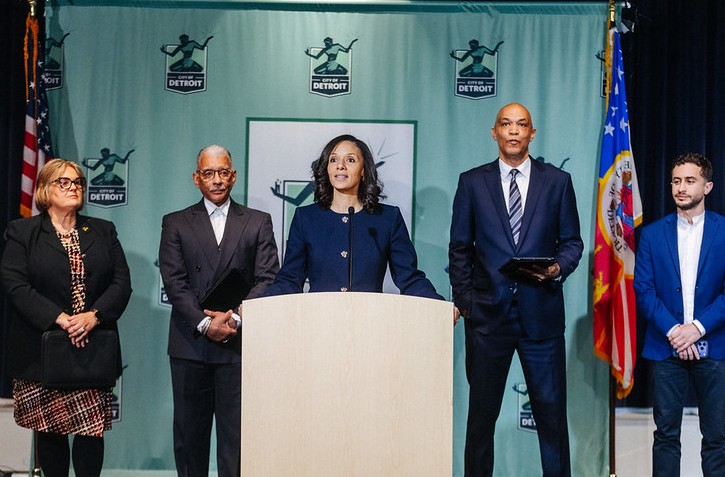
Mayor Sheffield was joined by Building Safety, Engineering & Environmental Department (BSEED) Director David Bell, Corporation Counsel Conrad Mallett, and Chief Public Health Officer Ali Abazeed today to announce the new strategies. They say the new tactics are designed to address serious safety issues before they have a chance to escalate to “catastrophic failures” that cause the building to become uninhabitable, causing traumatic displacement of residents.
“Detroiters who are renters deserve to live in safe, quality housing. Anything else is unacceptable,” said Mayor Sheffield. “We have too many properties in the city where landlords have the property decline without addressing critical health and safety issues. Starting today, the city of Detroit will be taking a much more aggressive and proactive approach on behalf of our residents.”
This initiative is anchored in three coordinated actions that identify risk earlier, intervene faster, and enforce compliance when necessary:
- Greater coordination between BSEED and the Detroit Health Department to conduct joint building inspections and refer buildings with significant health and safety violations to the Law Department.
- Initiating court-enforced consent agreements with known problem properties through the law department.
- Placing liens through the Department of Appeals and Hearings on properties that have multiple unpaid tickets for blight and/or not being code compliant.
“Mayor Sheffield has made it clear that housing quality is a priority issue that must addressed immediately and aggressively and I appreciate her personal commitment to this,” said BSEED Director Dave Bell. “At her direction, working with our partners in the Law Department, Health Department and Department of Appeals and Hearings will send a clear message to our most problematic landlords there will be accountability and very real consequences if they continue to leave their properties in disrepair.”
Here’s how each new strategy will work:
- Increased Health Department Role: As part of Mayor Sheffield’s and Chief Public Health Officer Ali Abazeed’s “Health in all policies” approach, Detroit Health Department inspectors will work alongside building safety inspectors to ensure that housing conditions are evaluated not only for structural integrity, but for their direct impact on resident health. This coordinated model allows the city to identify risks earlier, address them more holistically, and escalate enforcement when conditions threaten the well-being of tenants. Properties with significant longstanding issues will be referred to the Law Department for action.
“When housing conditions decline, we see the impact on residents’ health right away,” said Chief Public Health Officer Ali Abazeed. “It shows up in asthma, in injury risk, in the daily strain people carry. Working alongside our partners, and through our Health in All Policies approach, we can identify those risks earlier and act before they escalate. It’s about bringing a health lens into that work so we’re not just reacting to crisis but preventing it.”
- Consent Agreements: BSEED and the Law Department have identified 60 multi-unit apartment buildings that have had ongoing issues with maintenance and compliance related issues that continue to go unaddressed. Over the next several weeks, the Law Department will contact owners of each of the properties to enter into consent agreements that will be monitored by a court. The agreement will include timelines for repairs to be made and failure to comply with the agreement would trigger a lawsuit from the city and the possibility of the city being awarded control of the property based on it being a public nuisance.
"Under the Mayor’s new strategy, we are going to be much more ambitious in our use of consent agreements to compel owners to bring their properties up to code and this wave of 60 properties will set the tone going forward,” said Corporation Counsel Conrad Mallett. “We will be thoughtful in our sequencing so don’t overload our staff and the courts at once, but it’s happening.”
- Property Liens: Through the Department of Appeals & Hearings, which tracks payment and nonpayment of blight tickets, the city will file liens on properties that have significant numbers of unpaid judgments for being out of compliance with city code. Those liens only will be released when the tickets have been paid and resolved through addressing the underlying building condition issue. Having a lien on a property means that the first proceeds of any sale of the property would go to the city to pay for any outstanding fees or fines.
“The use of liens is an effective tool for getting property owners to not only pay the judgments against them, but also to address the issue that caused them to be ticketed in the first place, so they do not receive more tickets,” said DAH Director Julianne Pastula. “This is a tool we intend to use more frequently.”
“When students can't get to school, everything else suffers. Missing too many days means falling behind, losing confidence, and being cut off from the routines that keep young people on track. Ride to Rise is the city's direct answer to that reality,” said Dr. Chanel Hampton, Senior Director of Youth and Education Liaison to the Mayor.
To help make sure DDOT is a reliable resource for students and the public, Mayor Sheffield has proposed a $30M increase in the DDOT budget to provide for higher wages for more skilled maintenance technicians and bus drivers. DDOT is currently in the process of receiving 49 new buses and tomorrow will graduate one of its largest classes of new bus drivers, with more than 50 expected to join the ranks of DDOT.
"All of us at DDOT are proud to provide this service to all Detroit K-12 students to help them succeed in school and in life," said Executive Director of Transit Robert Cramer. “Every DDOT route, every day, is now available to Detroit students anytime they need it at no cost. That is a huge change for families across the city.”