
Mayor Duggan provides final residential blight removal program report
- Inventory of 47,000 abandoned Land Bank-owned homes in 2014 is now down to just 942 – with only 240 remaining on the demolition list.
- Effort has fueled $4.6 billion gain in generational wealth among Detroiters based on soaring home values
- Mayor outlines steps for environmental protection as part of final closeout of Detroit’s 2020 Proposal N voter-approved bonds.
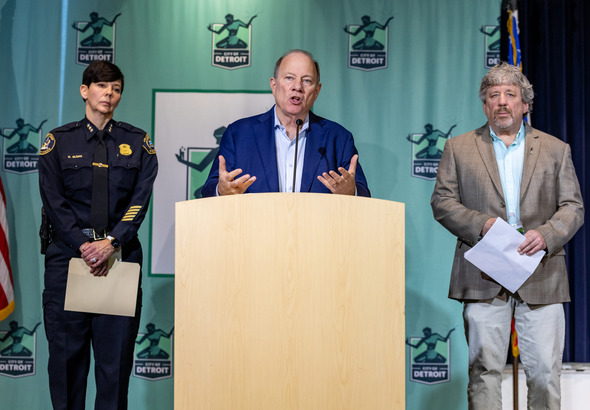
Once plagued with 47,000 abandoned Land Bank-owned homes, the City of Detroit now has fewer than 1,000 and should bring the number down nearly to zero in the next year, Mayor Mike Duggan said today. “It took 12 years, but Detroit has successfully demolished 27,000 houses and sold another 19,000 formerly abandoned homes to families who wanted to fix them up,” the Mayor said.
“As of today, the Detroit Land Bank has only 942 abandoned houses left – 240 to be demolished and 702 in the pipeline to be sold. The City will still have to be vigilant about enforcing the law on privately-owned abandoned houses, but next year as Proposal N closes out, the Land Bank should be rid of its entire inventory of vacant houses,” Duggan added.
Detroit’s historically successful blight removal effort has led to dramatic appreciation in value for the City’s homeowners. A University of Michigan study released earlier this year revealed that Detroit homeowners have gained a cumulative $4.6 billion in home wealth since 2014, with large increases in every one of Detroit’s more than 200 neighborhoods.
“Homeowners who stayed in Detroit and never left were the ones who gained the most wealth,” Duggan said. “That has been one of the most satisfying accomplishments of this administration.”
The Mayor recapped the two phases of the successful demolition effort: Phase 1 with $265 million in federal funding under the “Hardest Hit Fund” program and Phase 2 with the $250 million Proposal N bond approval.
The results are the following:
Hardest Hit Fund Phase (2014-2020)
Funding Demolitions Home Sales/Renovations
$265 Million 18,701 9,043
Proposal N Phase (2021-2025)
Funding Demolitions Home Sales/Renovations
$250 Million 8,277 (8,000 promised) 10,037 (8,000 promised)
Of the 942 remaining Land Bank-owned vacant homes, the final 240 demolitions will be done in the next 6 months, completing the demolition task entirely. The Land Bank also expects to sell the remaining 702 homes in 2026.
Final Close-out of Proposal N: Addressing sites with potential soil contamination
Mayor Duggan also outlined the steps needed to successfully close out Proposal N environmentally, which includes removing contaminated soil from every site at which the contractor used unacceptable backfill.
For the last 12 years, every time an investigation showed a contractor used backfill containing contaminants at unacceptable levels, the City has promptly removed the contaminated backfill, replaced it with clean backfill, and successfully charged the contractor with the costs.
The City has retained the environmental consulting firm Mannik & Smith Group and is testing every single site with a suspicion of contaminated backfill. Mayor Duggan outlined the two investigations underway:
- Iron Horse of Michigan, Inc. supplied several City contractors with soil from its sand and gravel pit in Milford Township that it represented was undisturbed, native soil. Soil from Iron Horse’s Milford facility has been used to backfill 424 demolition sites in Detroit. City testing has shown elevated levels of contaminants in soil at multiple sites supplied by Iron Horse, suggesting the strong probability that Iron Horse supplied contaminated and recycled soil. The City issued an order on November 3 suspending Iron Horse as an approved backfill source and has turned the matter over for investigation to EGLE, the State environmental agency responsible for environmental regulation and enforcement of sand and gravel pits. While the State investigation is ongoing, the City continues to test each one of the Iron Horse sites and is promptly removing any soil found to have contaminants at unacceptable levels. While earlier media reports characterized this issue as attributable to one demolition company – Gayanga – the investigation has shown that all City contractors using Iron Horse backfill have experienced the same level of elevated contaminants.
- The Detroit Office of Inspector General (OIG) reported this summer that demolition contractor Gayanga Co. LLC may have intentionally used backfill from unapproved sources. In September, Mayor Duggan asked the Detroit Police Department to open a criminal investigation into whether such activity occurred, who was responsible, and whether there was a basis for pursuing potential fraud charges against any individual. So far, 24 Gayanga sites have been found to have unacceptably high contaminant levels (not including sites where Gayanga used soil supplied by Iron Horse). The soil from all of these sites has already been removed by the City. Including sites where Gayanga used soil from Iron Horse, the City has removed soil from 58 sites to date, and the work is ongoing. In addition, in the 3-month investigation to date, DPD has identified 49 other suspect Gayanga sites, all of which are now being tested.
“As we have for the last 12 years, we will test every single site with suspected contaminated backfill, we will immediately remove any soil found unacceptable, and we will pursue reimbursement from the responsible contractor,” Mayor Duggan said. “We successfully closed out the Hardest Hit Fund program in this manner and Proposal N will be closed out the same way.”
The Mayor indicated that the City has retained $15 million in the Proposal N Closeout fund, making it extremely unlikely that the closeout will have a negative effect on the city’s finances.