
The public hearing at City Council’s Planning and Economic Development committee is scheduled for 10:20am on November 6
Adaptive Reuse
News & Events
Related Links
Videos
Documents
Forms
FAQs
District Map
Office Directory
Contacts
Contacts
FAQs
Sections
Web Apps
News
Events
FAQs
Statements
Newsletters
FAQs
Resolutions
Memos
INSTITUTIONAL ADAPTIVE BUILDING REUSE
WHAT DOES THE NEW CODE DO? : The zoning code amendments that were enacted in December 2025 makes it easier to reuse various public, civic, and institutional buildings, specifically:
- Child caring institution
- Educational institution
- Electric transformer station
- Fire or police station, post office, courthouse, and similar public building
- Gas regulator station
- Library
- Mortuary or funeral home
- Museum
- Religious institution
- Religious residential facility
- Residential-area utility facilities, public
- School, elementary, middle/junior high, or high
WHAT IS ADAPTIVE REUSE? “Adaptive reuse is the process of repurposing an existing building for a new use rather than demolishing it and building anew. This can involve converting buildings into affordable housing, office spaces, or other developments while retaining their historic features and prolonging their lifespan.” (From Leo) One of the key advantages of adaptive reuse is that it can be more cost-effective and faster than constructing a new building. It can also preserve buildings that help form the identity of a neighborhood.
WHAT’S THE CHALLENGE? Many of these institutional buildings are zoned for residential development (frequently R1(single family)) or R2(two-family)) so there are very limited potential uses permitted. Before the Adaptive Reuse Ordinance was effective, the only option was a rezoning, which can take upward of 6 months and can be slow and uncertain and may not even be possible for a small single building.
HOW DOES IT WORK? Many people ask us, “so how does it work?”. I want to renovate a building and I want to know if I need this new ordinance. First, check the zoning classification of the property you are interested in renovating. Refer to the zoning map to locate the property and confirm its zoning classification. Alternatively, you may request a zoning verification letter. When submitting your request, indicate that the project involves renovation of an institutional building and include the proposed use. The City will issue a letter confirming the applicable zoning designation and whether the proposed use is permitted. If the proposed use is permitted in the current zoning district, the Adaptive Reuse Ordinance does not apply, and no additional zoning review is required under this section of the code. You may proceed directly to the Buildings, Safety Engineering and Environmental Department (BSEED) and submit a change of use /rehabilitation permit. More information about this process can be found at the Development Resource Center www.detroitmi.gov/drc.
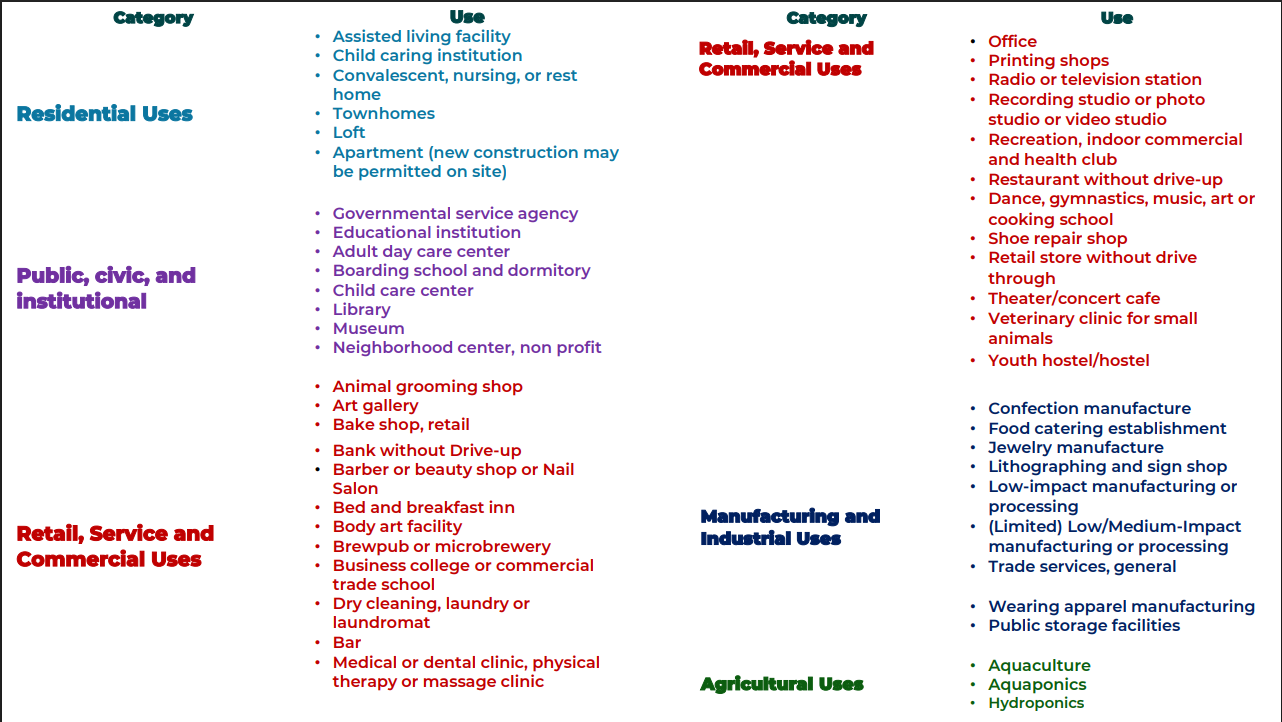
If the proposed use is not permitted in the zoning district, and the building proposed for renovation qualifies as an “Institutional Building” as defined in the Adaptive Reuse Ordinance posted on this webpage, you may propose redevelopment of the property under the ordinance. The Adaptive Reuse Ordinance allows a range of alternative uses for qualifying institutional buildings; a summary of these permitted uses is provided below. To initiate this process, submit your application through the building department (BSEED). This process will require Site Plan Review and a Special Land Use Hearing, as all uses provided under the Adaptive Reuse Ordinance are Conditional Uses. More information regarding these applications can be found at www.detroitmi.gov/drc.
WHY DID WE ENACT THIS CODE?
- Preserves historic anchor buildings to retain culture, character and fabric of neighborhoods
- Supports neighborhood investments with increased redevelopment opportunities
- Supports new housing efforts
- Promotes redevelopment activities that serve the day-to-day needs of local residents
- Reduces annual demolition costs by making it easier to reuse institutional anchors within residential communities
- Expedites investment as an individual rezoning for each institutional building burdens each proposal with time and money spent
- Allows a variety of redevelopment options to accommodate the unique challenges of adaptive reuse
The ordinance is now effective as of 12/23/25.
Past Meetings
- Adaptive Reuse at Citywide Dept. of Neighborhoods Meeting | April 7 2025
- Meeting Recording (Begins at 1:39 Timestamp)
Permitted Uses
Tactical Preservation
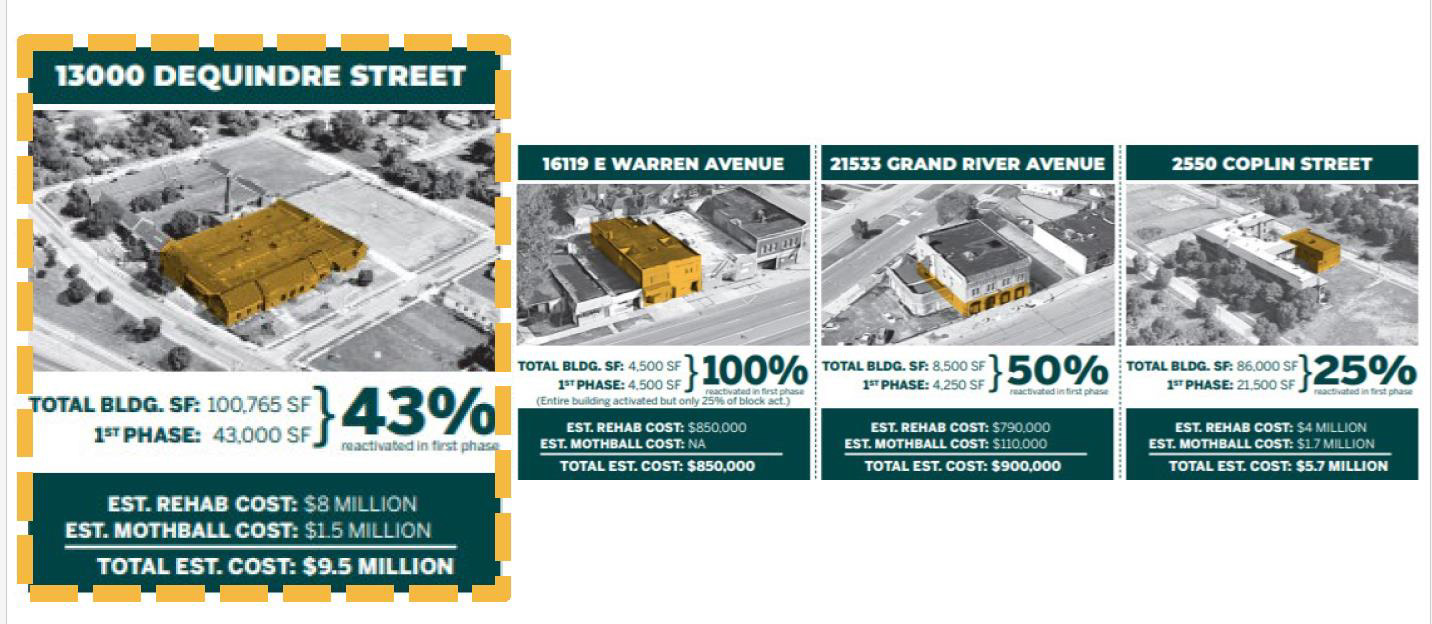
This ordinance also introduces tactical preservation into City ordinances. Tactical preservation is a building reuse strategy focused on the partial and incremental reuse of existing buildings through a Buildings & Safety (BSEED) process to ensure that the properties can be activated in a safe, efficient, environmentally sound, aesthetically responsive manner via modifications to development standards. That process will be in place when the ordinance is presented.
Resources
Quick Links:
- City of Detroit After Schools Study
- City of Detroit: Tactical Preservation
- Motor City Match
- DEGC Incentives
- MEDC Historic Tax Credit
Financing Tools
Quick Links:
- https://www.afterschooldetroit.com/resources
- https://www.motorcitymatch.com/
- https://www.degc.org/tax-incentives
- If your building qualifies, https://www.miplace.org/historic-preservation/programs-and-services/historic-preservation-tax-credits/
Quick contacts:
- DEGC / DBRA – brownfield, OPRA & CRA district setup, Motor City Match/Re‑Store
- City Housing & Revitalization Department – DHFF, SNF, HOME/CDBG NOFAs, NEZ certificates
- MEDC Community Development – MCRP & RAP
- State Historic Preservation Office (SHPO) – state historic credit and federal HTC
Kimani Jeffrey
City Planning Commission (313) 224-6376 [email protected]Gregory Moots
Lead Planner (313) 224-1358 [email protected]