
Detroit gains thousands of new residents for 3rd straight year, according to latest US Census Bureau estimate
- US Census data released today shows Detroit gained 5,060 residents since May 2025 estimate
- Detroit’s gain in residents leads all Michigan communities and one-year growth rate exceeds Michigan’s overall growth rate.
- Detroit is one of only three cities in Wayne County to grow since 2020
- Mayor Sheffield says her focus is continuing Detroit population growth trend through added housing units, as well as resident retention and attraction efforts.
The City of Detroit led all communities in Michigan in population growth in 2025 and now has seen three consecutive years of growth following six decades of annual decline, Mayor Mary Sheffield said today. Sheffield said that the new U.S. Census Bureau population estimate released today shows Detroit’s with a total 649,095 residents, a gain of 5,060 from last year’s estimate. Grand Rapids was second behind Detroit in growth, adding 1,700 new residents since last May’s population estimate.
Detroit’s growth rate eclipsed that of the State of Michigan over the past year. Since the Census estimate released one year ago, Detroit grew by 0.8%, whereas the State of Michigan as a whole grew by 0.28%. Detroit also is just one of three communities in Wayne County to have seen its population grow since 2020. According to the Census Bureau. The others are Canton Township and Sumpter Township.
Sheffield said that three consecutive years of robust population growth shows Detroit has become a city where longtime residents want to stay and others want to move. The Mayor added that Detroit increasingly is seen as a city of opportunity.
“I met a young woman the other day who just recently moved to Detroit from Memphis and before that had lived in Atlanta,” Mayor Sheffield said. “Historically, those have been cities that longtime Detroiters have left for, not the other way around. She told me she chose Detroit because she had been hearing such good things about it and saw it as a great place for opportunity and she’s thrilled with the choice she made.”
Census Bureau now counts residential units in vacant rehabs
In May 2024, Detroit saw its first increase in population since 1957 – a rise of 3,233. That was followed in 2025 by an increase of 6,583 new residents. This year’s increase of 5,060 brings the three-year total of nearly 15,000.
Sheffield added that much of Detroit’s population growth has been fueled by added housing units in what previously had been abandoned homes and apartment buildings. Prior to a successful challenge by the City of Detroit, abandoned buildings that were renovated as new residential units were not counted as such by the Census Bureau, meaning the occupants were not reflected in population estimates.
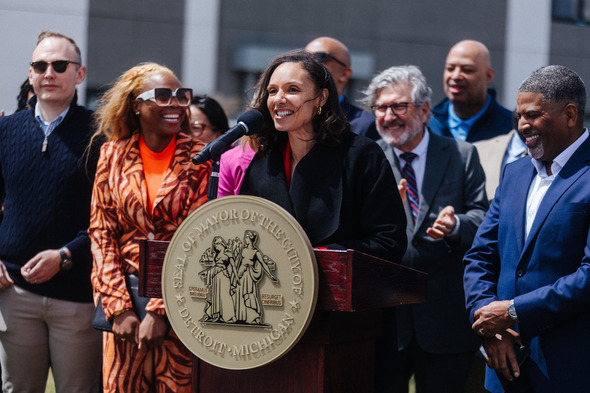
The Mayor made her announcement in front of the former Higginbotham school in the Garden Homes neighborhood near Wyoming and 8 Mile. The vacant school is now being converted into new residences which, along with two newly construction apartment buildings on the site, will add 100 more housing units when it opens early next year, thanks to a $35 million investment.
With the tremendous amount of renovation and new construction taking place in Detroit, Mayor Sheffield says she is optimistic that the growth trend will continue.

Shauna, a new resident who moved to Detroit from out of state.
“There are abandoned homes and commercial buildings across the city being renovated, and it’s happening at such a fast rate that we expect them to drive more annual population growth for the next few years,” Sheffield said. “Because we also know we’re going to run out of abandoned buildings, which is a great thing, it’s even more important to accelerate our pace of building new multi-family housing, and single-family homes.”
Sheffield has set a goal of building 1,000 new single-family homes over her four-year term and is developing strategies to speed up that process.
“We have an abundance of vacant residential lots in great areas of the city that are just waiting for new homes to be built on them,” said Sheffield. “If we can start to make that happen at scale, Detroit will continue to grow in population for years to come."