Mayor, Chief announce major reductions in overall crime and juvenile crime during Occupy the Summer
- Juvenile homicides down nearly 90% from last summer; Juvenile offenses also see reduction
- All categories of violent and nonviolent crime down during after 3rd quarter
- Mayor Sheffield in April announced 6-point community safety plan including 10-weeklong Occupy the Summer program, Neighborhood Action Teams, Safe Gun Storage and more
The City of Detroit saw a far safer summer this year compared to past years with major reductions in nearly every category of violent and property crimes, as well as significant reductions in crimes involving juveniles, Mayor Mary Sheffield and Chief Todd Bettison announced today.
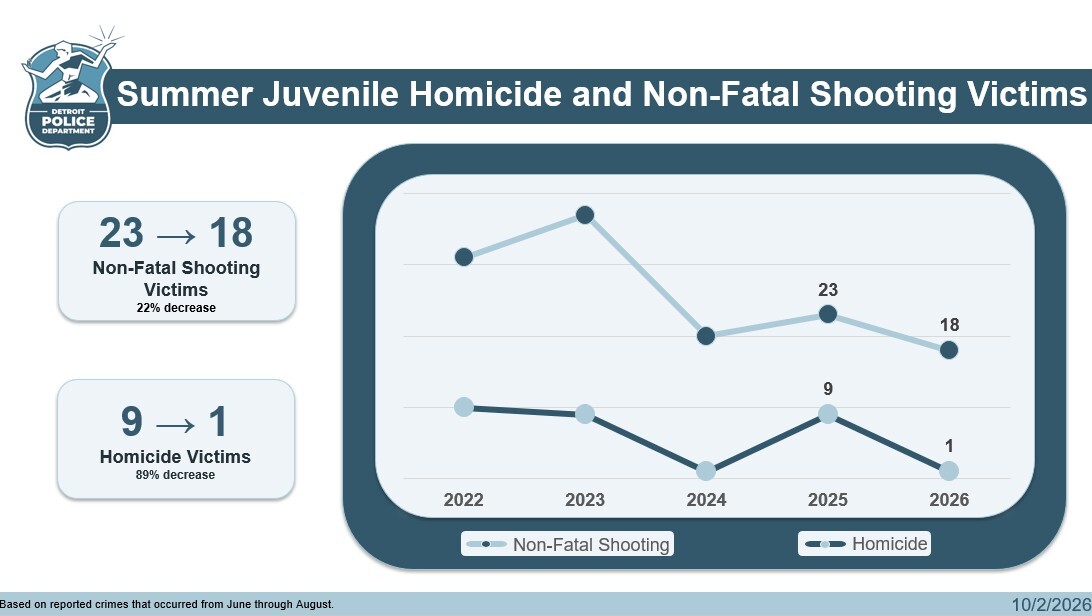
The number of juveniles homicide victims this summer plummeted 89%, from nine last summer to one this summer, while homicides overall dropped 25% and carjackings dropped nearly 35%.
Joined by DPD officers, community violence intervention groups and her office of neighborhood and community safety – Sheffield and Bettison pointed to an effective summer crime reduction strategy they unveiled in April. The centerpiece of that effort was the Mayor’s signature 10-weeklong Occupy the Summer initiative that included major weekend events, extended recreation center hours and a Late Night Basketball League to provide young people in the city more constructive recreational opportunities.
While many cities struggled throughout the summer with so-called Teen Takeovers, Detroit received national attention for its successful approach. Rather than relying only on enforcement, Mayor Sheffield doubled down on a strategy that balanced enforcement and accountability with providing young people more of the kinds of activities they said they wanted.
“I never bought into the idea that our youth are a problem to be solved. I believe they are an asset to be invested in,” said Mayor Sheffield. “Instead of a summer marked by youth violence as some had predicted, we saw a summer marked by young people by the thousands participating in 10-weeks for free events that gave them an opportunity to enjoy fun activities with friends and walk away knowing they are valued.”
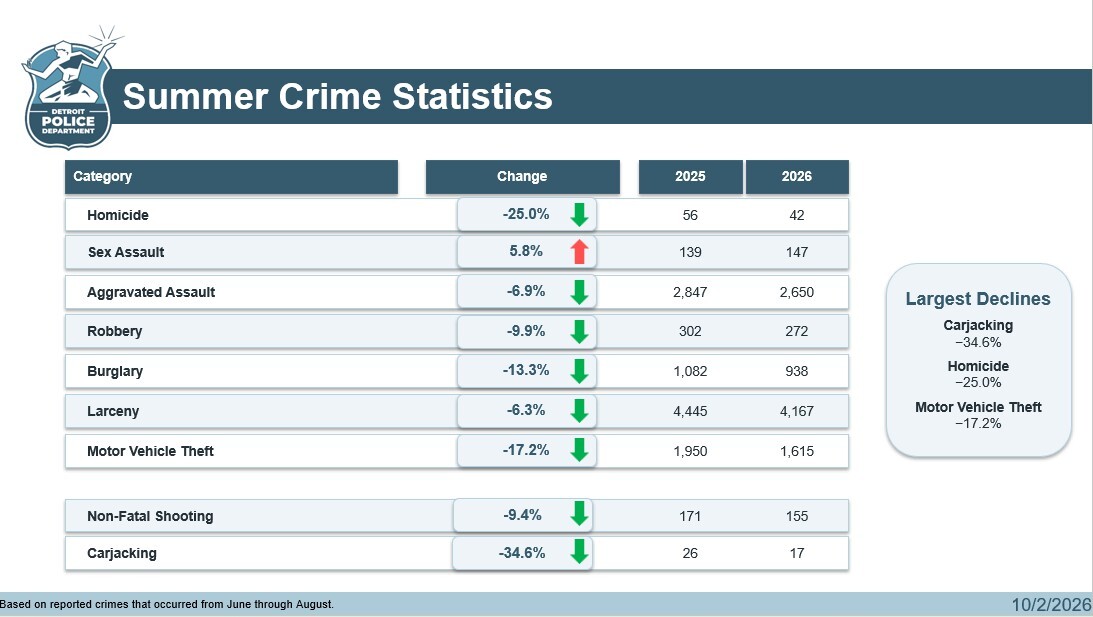
Below are key crime stats for the summer months of June, July and August of this year, compared to the same period the previous year:
A Safer Summer for Everyone
June 1 – August 31
Crime category 2025 2026 % change +/-
Homicides 56 42 -25.0%
Nonfatal Shootings 171 155 -9.4%
Burglary 1082 938 -13.3%
Larceny 4445 4167 -6.3%
Auto Theft 1950 1615 -17.2%
Fewer Summer Juvenile Violent Crime Victims
June 1 – August 31
Crime category 2025 2026 % change +/-
Juvenile Homicides 9 1 -89.0%
Juvenile Nonfatal Shootings 23 18 -22.0%
Fewer Summer Juvenile Criminal Offenders
June 1 – August 31
Juvenile Crime category 2025 2026 % change +/-
Robbery 22 14 -36.4%
Burglary 29 20 -31.0%
Nonfatal shooting 14 10 -28.6%
Larceny 48 47 -2.10%
Homicide 3 3 -0.00%

Chief Todd Bettison details the reduction in crime during the recent summer and throughout the first three quarters of the year.
In many cases, the Mayor’s Offices of Youth & Education and the Office of Neighborhood and Community Safety, were able to engage young people planning large teen gatherings and redirect their energy in more constructive directions, including helping to shape activities the city offered.
“Mayor Sheffield took a lot of criticism by taking an approach that valued our young people rather than vilify them, but the results show she was right,” said Teferi Brent, Chief of the Mayor’s Office of Neighborhood and Community Safety. “While many other cities struggled with this new dynamic and continued to have public safety problems, Detroit didn’t. That is a testament to the Mayor’s leadership, her understanding of the community and her commitment to supporting our youth.”
All categories of crime down after first three quarters of 2026
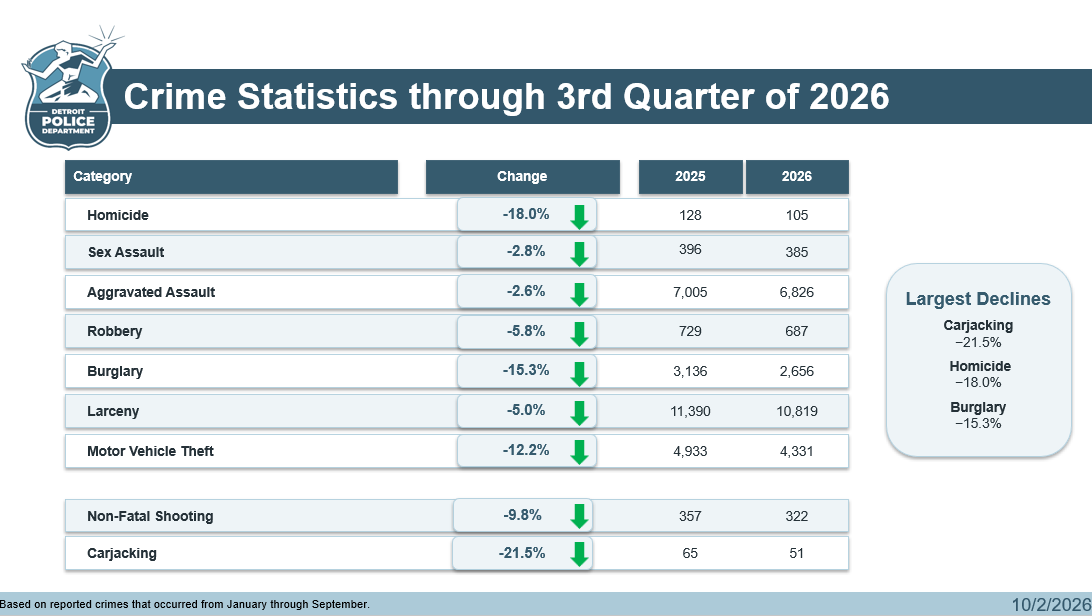
Detroit’s historic reductions in violent crime over the past several years has continued under the first 9 months of Mayor Mary Sheffield’s administration, according the DPD crime stats through the first three quarters of 2026. From January 1 – September 30, every category of crime measured by the city – violent and nonviolent – has seen reductions, many of them in the double-digits, compared to the same time last year.
“All Detroiters deserve the peace of mind of feeling safe in their city. We said from the beginning that we were going to stick with strategies that have brought about historic reduction in crime and layer on new ones to build on that progress,” said Mayor Sheffield. “Through DPD, our Office of Neighborhood and Community Safety, our law enforcement partnerships and community work, the results show that while there is always more work to do, our approach is creating increasingly safer neighborhoods.”
Key overall crime reduction amounts during the first three quarters of 2026 include:
Crime category 2025 (Q1-3) 2026 (Q1-3) % change +/-
Homicides 128 105 -18.0%
Nonfatal Shootings 357 322 -9.8%
Carjackings 65 51 -21.5%
Burglary 3136 2651 -15.5%
Auto Theft 4933 4323 -12.4%
Chief Bettison said that throughout his 30-year career, he can’t recall a time when every category of crime went down at the same time.
“When Mayor Sheffield re-appointed me as Chief, she charged me with building on the recent reductions in violent crime, and to substantially address property crimes such as burglary, auto theft and larceny - and she has supported our work every step of the way,” said Chief Bettison. “I am proud that we have been able to deliver significant reductions in both violent crime and property crime at the same time.
“Of course, it takes partnerships to be successful in this work, and we are fortunate to have the best partners at the federal, state, county and community levels,” Bettison added.
The Mayor and Chief Todd Bettison thanked all partners involved in the work, including:
- Wayne County officials including Executive Warren Evans, Prosecutor Kym Worthy, Sheriff Raphael Washington
- Federal officials including US Attorney Jerome Gorgon, as well as the FBI, ATF and Department of Homeland Security
- Michigan State Police and Michigan Department of Corrections
- Leadership of the courts, including 3rd Circuit Court Chief Judge Ed Ewell and 36th District Court Chief Judge William McConico
- Detroit-Wayne Integrated Health Network
- The City’s seven ShotStoppers community violence intervention groups: Detroit Friends & Family, Force Detroit, New Era Detroit, Detroit 300, Detroit People’s Community, Live in Peace and Team Pursuit, as well as Ceasefire Detroit.