Did you recently receive a letter from the Detroit Water & Sewerage Department (DWSD) regarding your water service line pipe material?
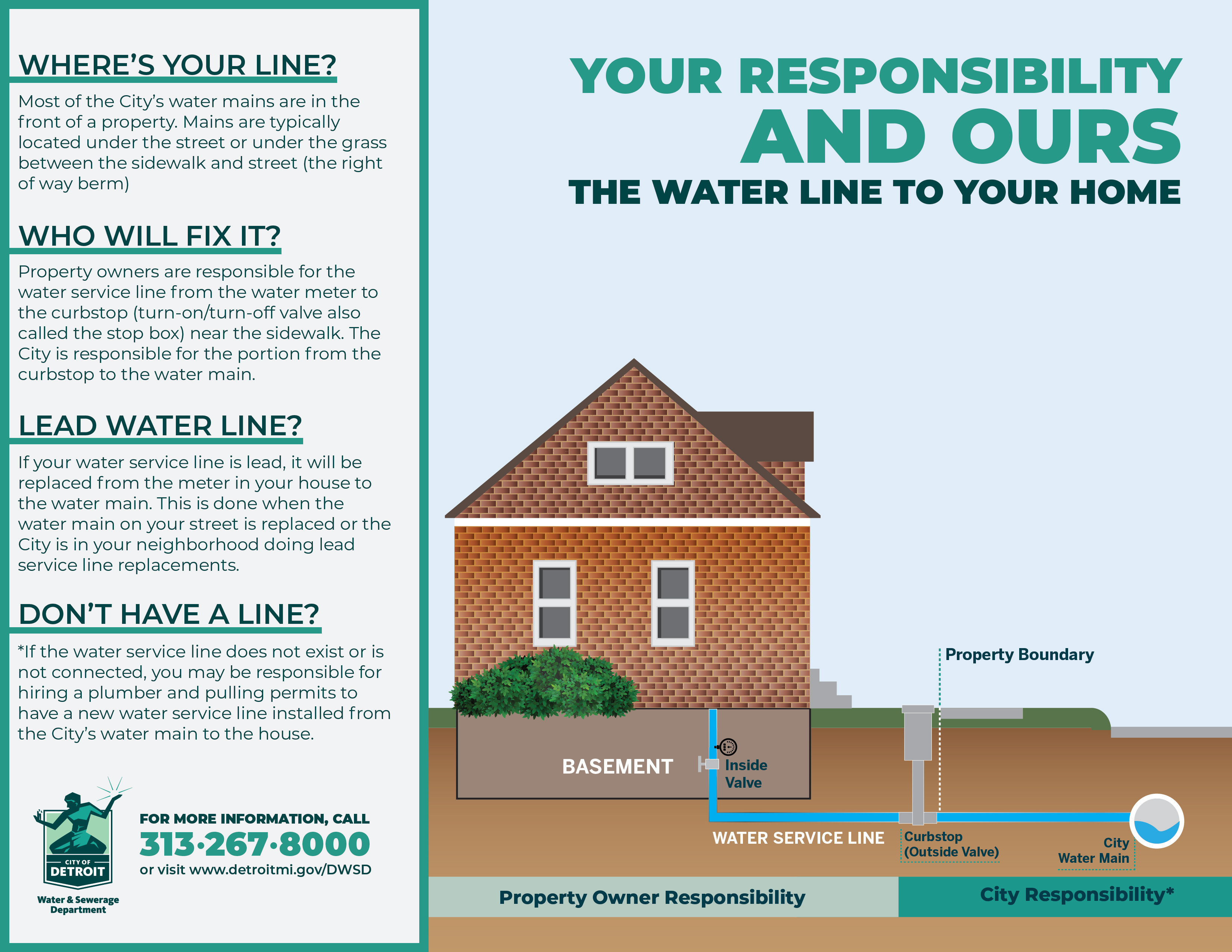
The service line is the pipe that brings clean and safe drinking water to your home or business from the city’s water main. Notifications were sent to properties with known or verified lead or galvanized service lines, and service lines of unknown pipe material which may be lead. Every city and township in America is required to send these notifications to any property that receives municipal water service and has lead and galvanized service lines. The June 30, 2025 notifications are based on updated verifications and predictive computer modeling and are indicated on this online map.
DWSD is replacing lead service lines at a rapid pace, starting with the most vulnerable neighborhoods, and it will take about 10 years to replace all the lead service lines in the city of Detroit.
To help verify if you have a lead service line, use this online tool created by NPR or watch this YouTube video produced by DWSD, and then complete this online self-verification form to let us know if you have a lead line visible from inside your home or business. Please note that completing this verification form does not guarantee DWSD will be able to replace your lead service line in the near future as that is dependent upon funding resources. Learn more about DWSD's Lead Service Line Replacement Program below.
Learn more about the DWSD Lead Service Line Replacement Program
The Detroit Water and Sewerage Department (DWSD) estimates there are more than 80,000 lead service lines delivering water to homes in Detroit. In the city of Detroit, lead service lines are most likely to be found in single-family homes built before 1945.
The water leaving the treatment plants that serve the city of Detroit does not contain lead, but lead can be released into drinking water from corrosion in lead service lines and household plumbing that contains lead. The water provided to DWSD customers contains a corrosion inhibitor to reduce corrosion of lead and other pipe materials into drinking water. If present, elevated levels of lead can cause serious health and developmental problems, especially for pregnant women and young children. Since 2018, DWSD has been working to verify lead service lines and replace them as part of the Asset Management Program.
Detroit Water & Sewerage Department
Lead Service Line Replacement Program
Lead Service Lines Replaced
in 2026
445
Lead Service Lines Replaced
since 2018
16,163
Data as of July 20, 2026
Neighborhood-by-Neighborhood Approach
Since 2018, DWSD has replaced 3,000 lead service lines through water main replacement projects and individual lead service line projects throughout the city. DWSD continues to replace the existing lead service lines – the pipe providing water to a home from the water main – while on the same block as the water main replacement project.
In Fall of 2022, DWSD received $90 million in funding from state and federal governments to dramatically speed up its Lead Service Line Replacement Program. In May 2023, DWSD started a neighborhood-by-neighborhood approach to replace lead service lines. Neighborhoods are prioritized based on density of housing built prior to 1945, significant number of children and seniors in the area, and likely high number of low-income households based on Census tracts.
DWSD started the accelerated lead service line replacements in two areas of Claytown in District 6 on Detroit’s southwest side. See below for current and upcoming neighborhoods.
Do You Have a Lead Service Line?
- Do I have a lead service line? Use this online tool created by NPR or watch this YouTube video produced by DWSD to determine if you have a lead service line.
- Take a photo of your service line entering your house or building and complete this online self-verification form to let us know if you have a lead line.
- When can I get my lead service line replaced?
- DWSD is replacing lead service lines throughout Detroit on a neighborhood-by-neighborhood basis. DWSD will contact you before coming to your neighborhood.
- DWSD will replace the lead service line, with homeowner/occupant permission, when workers are on your block replacing the water main. If water main replacement is taking place in your neighborhood, you will be notified in advance of construction beginning.
- How will I know if my street is next? The timing of outreach to your property will be dependent on the construction schedule and as funding becomes available. Check the list below to see the list of current and upcoming neighborhoods.
- How can I get my water tested? DWSD, in partnership with the Great Lakes Water Authority, will test for lead in the water at no charge at homes where a child has tested positive for elevated blood lead levels, or when DWSD is replacing a lead service line. Learn more at the Lead and Water Testing page, submit this online form or complete and download this form. The participating household must collect the tap water sample by adhering to the provided instructions. Any home where a collected sample has over 12 parts per billion of lead will be provided a water filter that meets the ANSI/NSF 53 standard for lead removal.
What steps can I take to reduce exposure to lead drinking water?
- Run your water to flush out lead. The more time water has been sitting in your home's pipes, the more lead it may contain. Therefore, if you water has not been used for several hours, run the water before using it for drinking or cooking. This flushes lead-containing water from the pipes. If you do not have a lead service line, run the water for 30 seconds to two minutes, or until it becomes cold or reaches a steady temperature. If you do have a lead service line, run the water for at least five minutes to flush water from both the interior building plumbing and the lead service line.
- Use only cold water for drinking and cooking. Do not cook with or drink water from the hot water tap; lead dissolves more easily into hot water.
- Use only filtered water or bottled water for preparing baby formula.
- Do not boil water to remove lead. Boiling water will not reduce lead levels. in the event DWSD issues a boil water advisory due to low water pressure (such as caused by a large water main break), water users in the designated advisory area will be advised to boil water before using for cooking, drinking, and brushing your teeth. Residents with lead service lines should only boil filtered water - not water directly from the tap.
- Consider using a filter to reduce lead in drinking water. The Detroit Health Department recommends that any household with a child or pregnant woman use a certified lead filter to reduce lead from their drinking water. Look for filters that are tested and certified to NSF/ANSI Standard 53 for lead reduction. Some filters options include a pour-through pitcher or faucet-mount systems. If the label does not specifically mention lead reduction, check the Performance Data Sheet included with the device. Be sure to maintain and replace the filter device in accordance with the manufacturer's instructions to protect water quality.
- Get your child tested. Contact the Detroit Health Department at 313-876-0133 or your healthcare provider to find out how you can get your child tested for lead if you are concerned about exposure.
- Identify older plumbing fixtures that likely contain lead. Older faucets, fittings, and valves sold before 2014 may contain higher levels of lead, even if marked "lead-free". Faucets, fittings, and valves sold after January 2014 are required to meet a more restrictive "lead-free" definition but may still contain up to 0.25 percent lead. When purchasing new plumbing materials, it is important to look for materials that are certified to meet NSF standard 61.
- Clean your aerator. The aerator on the end of your faucet is a screen that will catch debris. This debris could include particulate lead. The aerator should be removed monthly to rinse out any debris.
- Test your water for lead. To request for your water to be tested, please visit www.detroitmi.gov/leadsafe and search "lead and copper sample request form." If you do not have internet access, please call the Detroit Lead Safe Resource Line at 313-267-8000 and press option 7 for further assistance.
Current Neighborhoods*
- Chandler Park
- Dickerson to Alter from i94 Service Drive to E Warren
- Morningside
- Alter to E Outer Dr from i94 Service Drive to E Warren
- Wade
- E Outer Drive to Longview from Conner to Chalmers
- Eden Gardens
- Flanders to E Outer Drive from Gratiot to Chalmers
- Hawthorne Park
- Hawthorne to Saint Aubin from E Seven Mile to E McNichols
- Cadillac Heights
- Hawthorne to Saint Aubin from E Seven Mile to E McNichols
- Greenfield-Grand River
- Saint Marys to Asbury Park from Grand River to Schoolcraft
Future Neighborhoods* (Not in order of construction)
- Grandmont
- Boynton
- Springwells
- Dexter-Linwood
Completed Neighborhoods** (Restoration may still be in progress)
- Fitzgerald
- Turner from Puritan to John C Lodge Service Dr
- Woodingham from Puritan to John C Lodge Service Dr
- Woodingham to Stoepel, from McNichols to John C Lodge Service Drive
- Bagley
- Monica to Stoepel, from 7 Mile to Curtis
- Barton-McFarland
- Kentucky to Wisconsin from Joy to Tireman
- Claytown
- Michigan to Saint Stephens, Ternes to Casper
- Florida to Chopin, McGraw to Edsel Ford Service Dr
- Dexter-Linwood
- Burlingame to Glynn Ct, from Dexter to Linwood
- Springwells
- Vernor to Homer, Lawndale to Springwells
- Oak Grove
- Greenlawn to Stoepel, from Pembroke to W Outer Dr
- Oakman Blvd
- Stoepel to Monica, from Oakman Blvd to Elmhurst
- Pulaski Park
- Hoover to Dresden, from E State Fair to 7 Mile
- Russell Woods
- Waverly to Cortland, Davison to Dexter
- Fischer Street
- Fischer from Mack Ave to Vernor
- Pingree Park
- Seminole to Burns, from E Forest to Mack
- Jamison
- Clairmount to Vicksburg, from Dexter to Linwood
- Hope Village
- Doris to Davison, from Livernois to Linwood
- Morningside
- Balfour to Audubon, from W Warren to Mack
- Fitzgerald (west)
- Birwood to Greenlawn, from McNichols to John C Lodge Service Drive
- Pilgrim Village
- Petoskey to Log Cabin, from Puritan to John C Lodge Service Drive
- Banglatown
- Joseph Campau to Conant, from Davison to Carpenter
- Grand River-i96
- Ward to Greenlawn, from i96 Service Drive to Grand River
- Pingree Park
- Gratiot to E Forest, from Seminole to Rohns
- Dexter Linwood (south)
- Davison to Burlingame, from Dexter to Linwood
- Nardin Park
- Courtland to Joy, from Livernois to Dexter
- Oakman Blvd
- Elmhurst to Grand River, from Jeffries Freeway to Livernois
- Petoskey-Otsego
- Joy to Grand Blvd, from Grand River to Linwood
- Gateway Community (west)
- Webb to Glynn, from John C Lodge Service Drive to Woodward
*Lead service line replacement will take place on specified streets within these neighborhoods. Streets are chosen based on available data including age of the homes, number of seniors and children, likely high number of low-income households based on Census tracts, and verified lead services. THE ENTIRE NEIGHBORHOOD IS NOT INCLUDED IN THE PROJECT. If your street is not listed, DWSD will return to your area to replace the lead service lines. Per state law, all lead service lines will be replaced by 2040.
**Lead service line replacement was completed at responsive houses.